



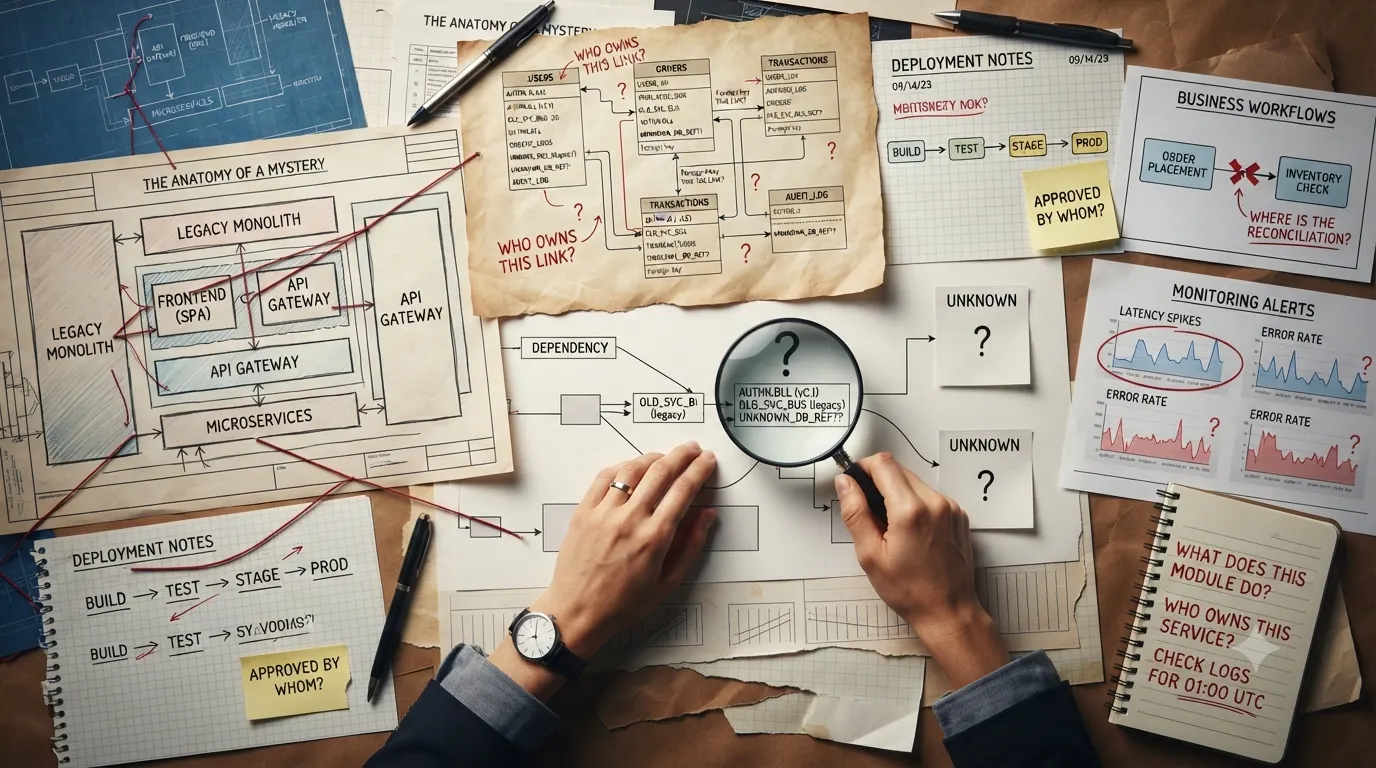

You can learn a surprising amount about a software system without reading every line of code.
Experienced engineers don't necessarily start by opening random files.
They look for signals.
The goal isn't to understand everything in an hour.
It's to understand where the important questions are.
They Look at How the System Is Structured
The first question is often simple:
“What are the major parts of this system?”
What is the application?
Where is the database?
What external services does it depend on?
How does data move?
How is it deployed?
A clear high-level picture can reveal problems quickly.
They Look for the Important Workflows
Not every part of the system matters equally.
An experienced engineer wants to know:
What does the business depend on?
Which workflows are critical?
Where does important data enter?
Where does it go?
What happens when something fails?
Understanding those paths is usually more useful than reading hundreds of files.
They Look at How Changes Are Made
This tells you a lot.
How does code reach production?
Are deployments automated?
Is there a testing process?
Can releases be rolled back?
Who approves changes?
A technically modern application can still have a risky delivery process.
They Look at Dependencies
External services matter.
So do internal dependencies.
What happens if a payment provider changes?
What happens if an API is unavailable?
What happens if a database table changes?
What parts of the application depend on one another?
The more tightly connected everything is, the more carefully changes need to be made.
They Look for Signs of Fear
Sometimes the strongest signal isn't technical.
It's what developers say.
“Nobody knows why this works.”
“Don't touch that.”
“Only one person understands this.”
“We have to deploy it this way.”
Those statements point toward areas that deserve investigation.
They Look at the Data
Data often tells the real story.
How is it structured?
Is important information duplicated?
Are there strange exceptions?
Are relationships clear?
Are there manual processes around the data?
A clean interface can hide a messy data model.
The opposite can also be true.
They Look at the Difference Between the Code and Reality
Perhaps the documentation says one thing.
The users do another.
Perhaps the system was designed for one workflow but employees have created workarounds.
Perhaps a feature exists but nobody uses it.
These gaps are important.
They tell you what the system actually is, not just what someone intended it to be.
The First Hour Isn't About Finding Fault
A good technical review isn't a search for someone to blame.
It's about finding risk, understanding constraints and identifying where improvement will have the greatest effect.
You don't need to know everything about a system to ask the right questions.
Sometimes the first hour is valuable precisely because it shows you what you need to investigate next.