



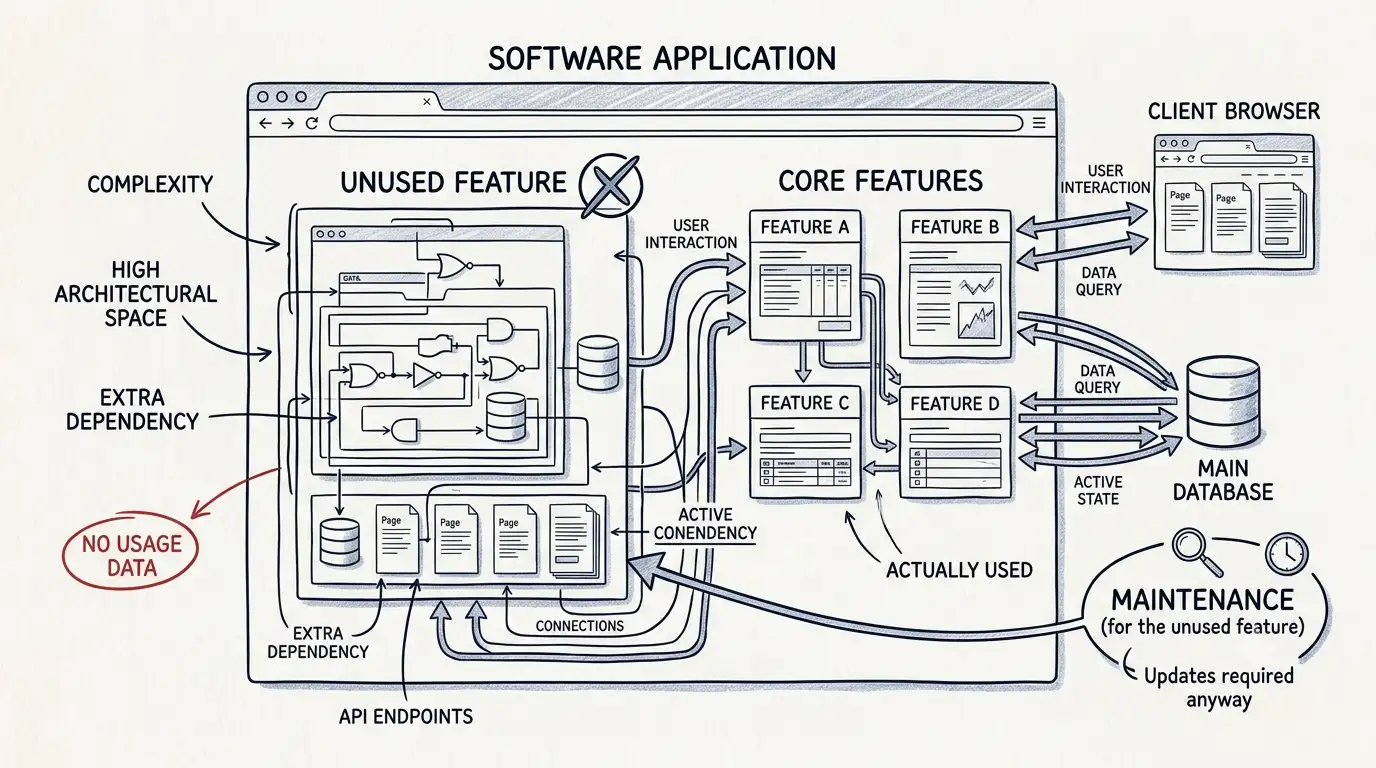

A software feature can cost thousands to build and almost nothing to maintain.
That sounds good.
Until you realise nobody uses it.
Then the feature becomes expensive in a different way.
Features Have a Cost Beyond Development
The obvious cost is development time.
But every feature also adds:
Code
Testing
Documentation
Support
User-interface complexity
Future maintenance
Security considerations
Technical dependencies
A feature that nobody uses still exists.
Someone still has to understand it.
Someone still has to test it when other parts change.
Why Do Unused Features Get Built?
Usually, there was a reasonable reason at the time.
A customer requested it.
Someone thought it might be useful.
A competitor had it.
Management wanted the option.
A developer suggested it.
The problem isn't that the decision was necessarily wrong.
The problem is that very few teams go back later and ask:
Did this actually help?
Software Tends to Accumulate
A system gets bigger one feature at a time.
Nobody notices the problem immediately.
But after a few years, users are presented with dozens of options.
The important workflows become harder to find.
New developers have more code to understand.
Testing takes longer.
Every change touches more areas.
The software becomes complicated partly because nobody is willing to remove anything.
Usage Should Influence Decisions
This doesn't mean every feature needs thousands of users.
Some features are intentionally used rarely.
A month-end financial process might only run once a month and still be critical.
An emergency function may be used once a year and still be necessary.
So “low usage” alone isn't enough.
The better question is:
What value does this feature provide relative to its cost and complexity?
That gives you a more useful picture.
Sometimes Removing a Feature Is the Improvement
Removing something from software can feel uncomfortable.
People worry that somebody might need it later.
But keeping everything forever isn't free.
A feature that has no meaningful use, no clear owner and no business value may simply be making the system harder to maintain.
Before removing it, of course, understand what depends on it.
Then make the decision deliberately.
Good Software Gets Smaller Sometimes
We tend to measure software progress by what gets added.
New feature.
New module.
New integration.
New dashboard.
But mature software teams also remove things.
They simplify workflows.
They consolidate duplicate functionality.
They retire old components.
They reduce unnecessary options.
That is real engineering work.
The goal of software isn't to contain as many features as possible.
It's to help people accomplish what they actually need to do.
Sometimes the best feature is the one you decide not to build.
And sometimes the best improvement is removing one that shouldn't have survived in the first place.