



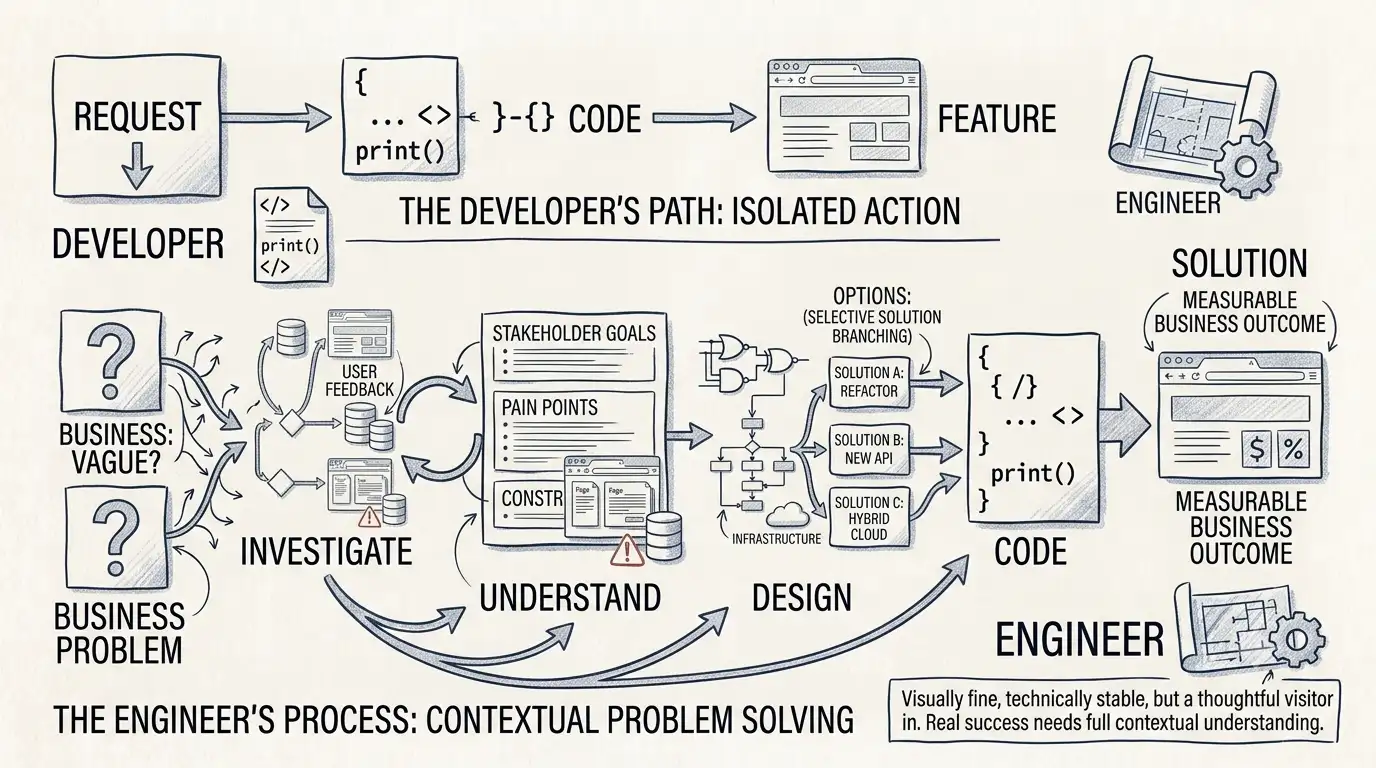

Writing code is part of software engineering.
It isn't the whole job.
A developer can be very good at producing clean, functional code and still miss the bigger problem the software is supposed to solve.
That's the difference between writing code and solving a software problem.
Code is the implementation
Imagine a business wants employees to approve customer requests faster.
The obvious request might be:
“Build an approval screen.”
A developer can build the screen.
But what if the real problem is that managers receive incomplete information?
Or that requests are being reviewed by the wrong people?
Or that employees have to enter the same data into two systems before approval?
The approval screen may work perfectly.
The process may still be slow.
That's why good engineering starts before the code.
Engineers ask “why?”
A strong engineer doesn't only ask:
“What should I build?”
They also ask:
“Why are we building it?”
That question can sometimes uncover a much simpler solution.
Maybe a new feature isn't required.
Maybe an existing feature needs to change.
Maybe the process needs to change instead of the software.
Maybe the software is working correctly but the business rule is wrong.
These aren't always comfortable questions.
They're useful ones.
Technical skill still matters
This isn't an argument against good coding.
Quite the opposite.
A good engineer needs strong technical skills.
They need to understand architecture, databases, security, performance, testing, deployment and the technology they're working with.
But technical knowledge becomes much more valuable when it is applied to the right problem.
The best implementation of the wrong idea is still the wrong solution.
Engineers think about what happens next
A developer may ask:
“Can I make this feature work?”
An engineer should also think about:
How will this be maintained?
What happens when the data changes?
What happens when something fails?
Who will use it?
What happens when the business changes?
How will another developer understand it?
What does this decision make harder later?
The software has to survive beyond the first release.
Sometimes the best engineering decision is not to code
This is one of the hardest lessons in software.
You don't always need to build something.
Sometimes the answer is:
Change the process.
Remove a requirement.
Use an existing system.
Simplify the workflow.
Automate a small part.
Stop doing something that no longer provides value.
A team that measures its success by lines of code will naturally find reasons to write more code.
A team focused on outcomes will look for the simplest solution.
That's the difference
A developer writes software.
An engineer takes responsibility for the problem the software is supposed to solve.
Sometimes those roles overlap completely.
Sometimes they don't.
The difference becomes particularly important when you're working on an existing system, where every technical decision has consequences beyond the feature currently being requested.
Good engineering isn't about writing more code.
It's about making better decisions about what code should exist in the first place.