



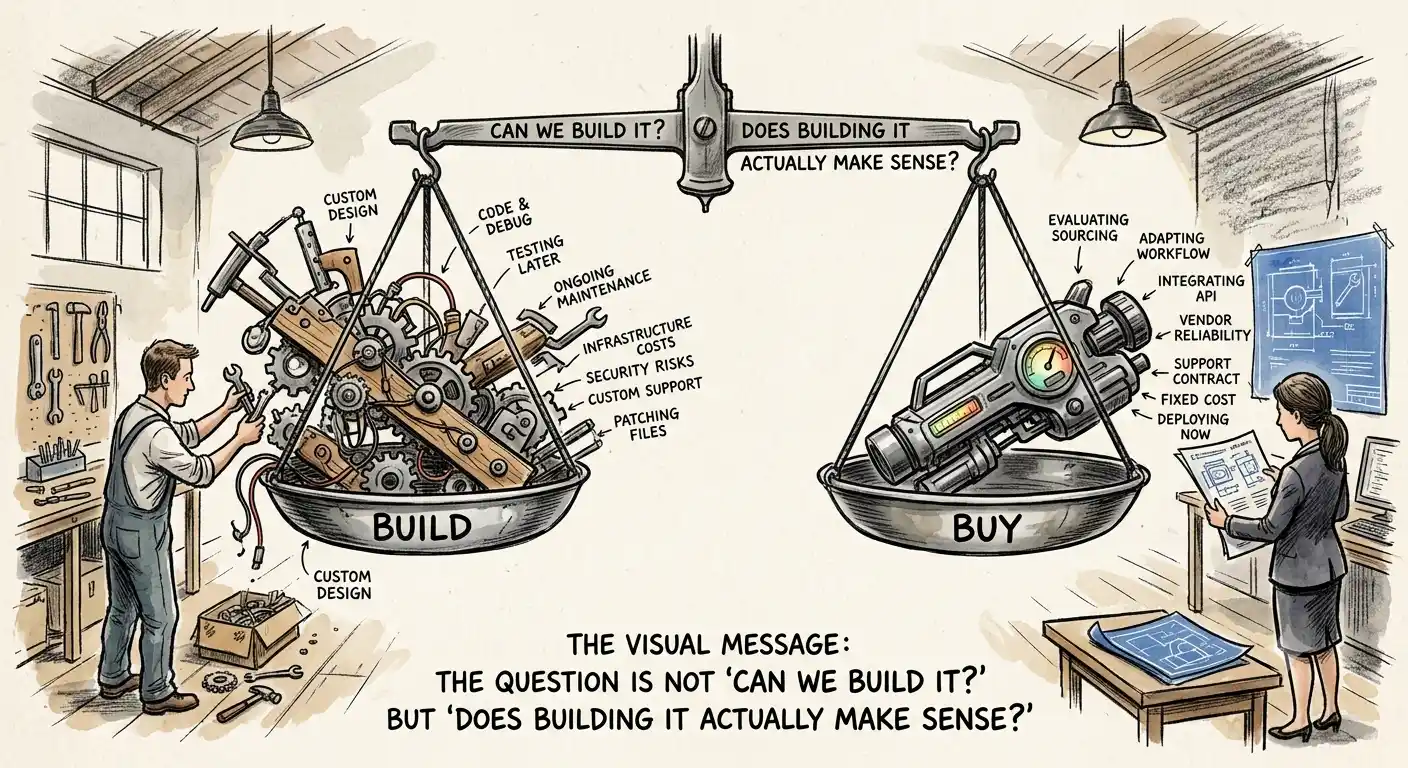

Building custom software can be attractive.
You get exactly what you want.
You control the roadmap.
You aren't dependent on someone else's product decisions.
But those benefits don't mean custom software is always the right choice.
Sometimes buying is better.
Building software has a long tail
The obvious cost is development.
But after that comes:
Maintenance
Security
Infrastructure
Updates
Bug fixes
Support
Backups
Monitoring
Future development
If a commercial product already solves the problem well, building your own version may not create enough value to justify that responsibility.
Don't build simply because you can
A company may say:
“We need a CRM.”
That doesn't automatically mean it should build one.
There are mature CRM products available.
Building one from scratch would mean taking responsibility for a problem that many other companies have already solved.
The same can apply to accounting, project management, help desks, HR systems and many other common business functions.
But buying isn't always better
Commercial software has its own trade-offs.
You may have to adapt your process.
Important features may be missing.
Pricing can change.
The vendor controls the roadmap.
Integrations may be limited.
Data portability may matter.
A product can also become expensive as the business grows.
So the answer isn't:
“Always buy.”
It's:
“Understand what you actually need before deciding.”
Where custom software makes sense
Building can be a strong choice when the software is closely connected to what makes the business different.
For example, a company may have a unique operational process that gives it an advantage.
Trying to force that process into a generic product may create more problems than building something specifically for it.
Custom software can also make sense when:
Existing products don't solve the core problem.
Integration requirements are highly specific.
The workflow is strategically important.
The business needs control over how the system works.
The key word is important.
Compare total cost, not just purchase price
When comparing buy versus build, look beyond the initial numbers.
Consider:
Buying
Subscription or licensing cost
Implementation
Customisation
Integration
Vendor dependency
Migration risk
Building
Development
Infrastructure
Maintenance
Security
Support
Future changes
Internal knowledge
The cheapest option today isn't necessarily the cheapest option over five years.
Sometimes the answer is a combination
You don't have to choose one approach for the entire business.
Use commercial software where it makes sense.
Build custom components where differentiation matters.
Connect them carefully.
That can provide the best balance between control and effort.
The important thing is not whether the software was built by your team.
The important thing is whether the solution makes business sense.