



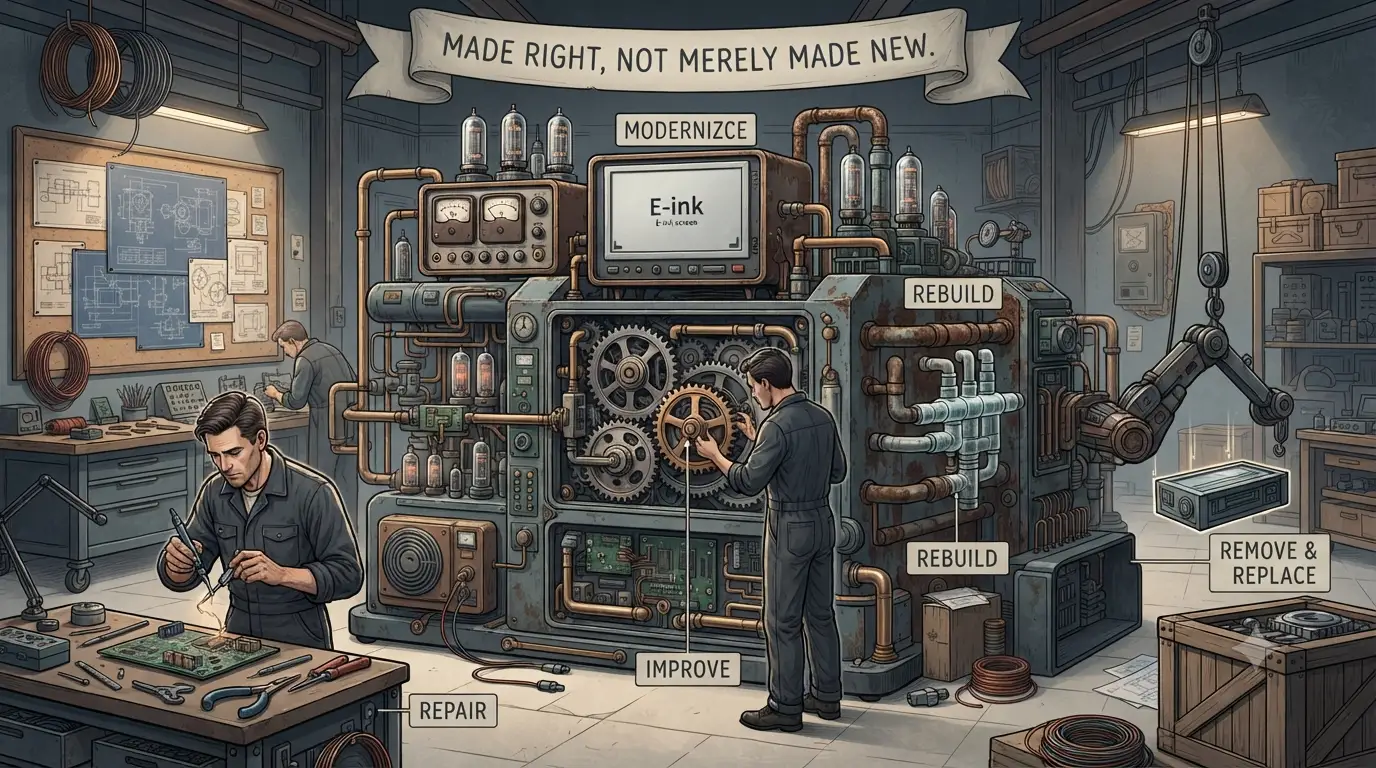

There is a strong temptation in software to replace things.
A new framework.
A new architecture.
A new application.
A new interface.
Sometimes a complete replacement is exactly what a business needs.
But “new” should never be the objective by itself.
The Goal Is to Make Things Right
When a business comes to us with an existing system, the first question shouldn't be:
“What technology should we replace this with?”
It should be:
“What isn't working today?”
Maybe the application is slow.
Maybe users have built workarounds.
Maybe the system is difficult to maintain.
Maybe important integrations keep failing.
Maybe the business has changed.
Maybe the software simply needs to be cleaned up and improved.
Each problem has a different answer.
Sometimes Fixing Is Enough
A broken feature doesn't need a new application.
A slow query doesn't require a new architecture.
A poor report doesn't necessarily require a new reporting platform.
Start with the problem.
Understand why it exists.
Then fix the smallest thing that solves it properly.
Sometimes Improvement Is the Answer
Existing software can still have value even when it has problems.
You might improve:
A difficult workflow
Reporting
Performance
Integrations
User experience
Deployment
Testing
Monitoring
The system doesn't have to become completely new.
It just needs to become better at doing what the business needs.
Sometimes Modernization Is Necessary
There are cases where the underlying technology creates too much risk.
Perhaps the platform is unsupported.
Perhaps security updates are becoming difficult.
Perhaps the architecture prevents meaningful changes.
In those situations, modernization may be necessary.
But even then, the objective isn't “use newer technology.”
The objective is to reduce risk and make the system easier to operate and change.
And Sometimes You Really Should Replace It
There are systems that have reached the point where continued investment no longer makes sense.
Maybe the business process has changed completely.
Maybe a commercial product now solves the problem better.
Maybe the existing system is too expensive to maintain.
Maybe the architecture is beyond practical repair.
In those situations, replacement can be the right decision.
The important thing is that the decision comes from evidence.
Not fashion.
Not fear.
Not because someone wants to work with a newer technology.
New Isn't the Same as Better
A new system can still have:
Poor requirements
Bad architecture
Unnecessary features
Weak integrations
Difficult maintenance
Poor user experience
New code doesn't automatically solve old thinking.
That's why we care more about the problem than the technology used to solve it.
Make It Right
Sometimes that means fixing a bug.
Sometimes it means removing a feature.
Sometimes it means modernizing part of the architecture.
Sometimes it means rebuilding.
Sometimes it means replacing the entire system.
There isn't one answer.
The right answer depends on what the business actually needs.
That's the principle we come back to again and again:
Don't make software new just for the sake of making it new.
Make it work properly.
Make it understandable.
Make it maintainable.
Make it useful to the business.
That's what fixing software really means.