



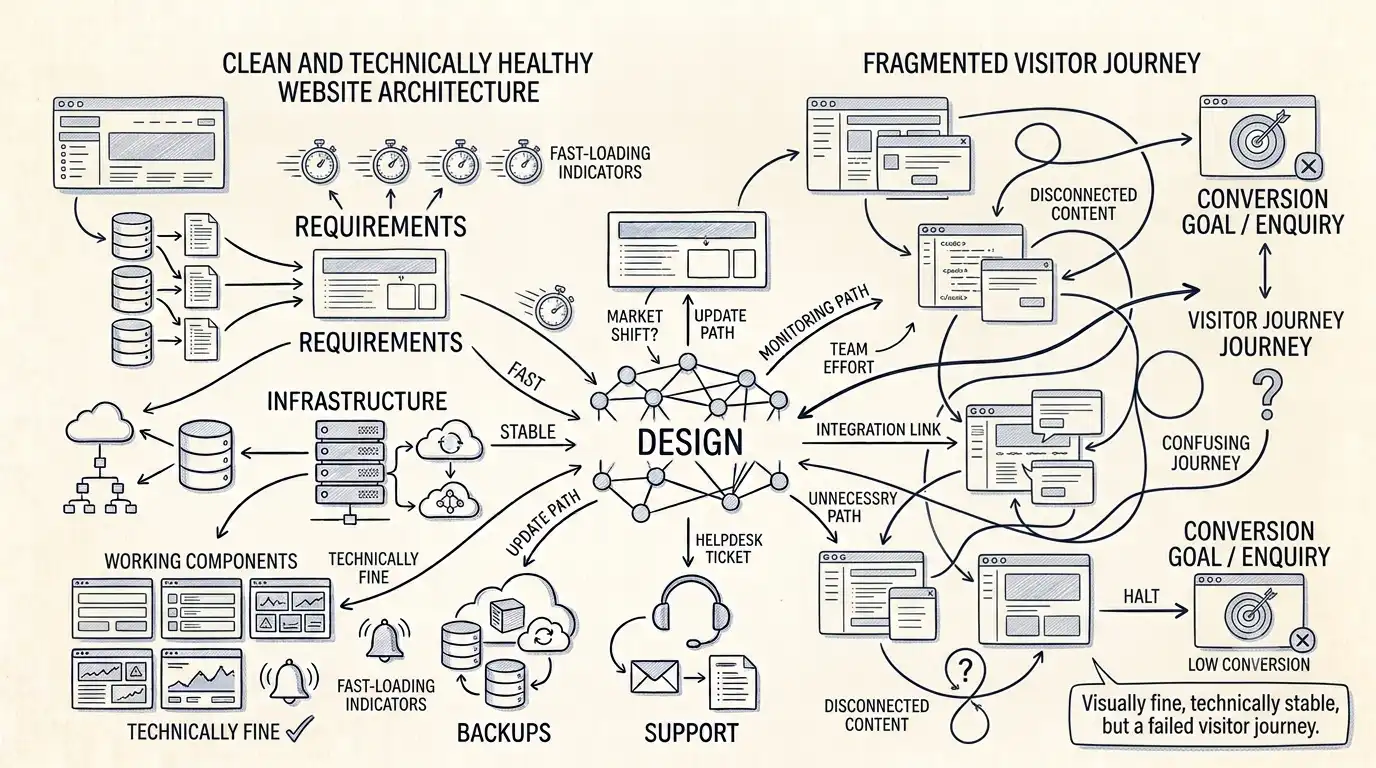

A website can have no obvious technical errors and still be failing the business.
It loads.
It's responsive.
The forms work.
There are no broken links.
The code is reasonably clean.
And yet, potential customers leave without doing anything.
That's because a website isn't only a technical product.
It's part of how a business communicates.
Technical Quality Is Only One Layer
A website has several jobs.
It needs to work technically.
But it also needs to make sense to the person visiting it.
Can they understand what the company does?
Can they tell whether it's relevant to them?
Can they find the information they need?
Do they trust the company?
Do they know what to do next?
A technically perfect website can still fail these tests.
The Business Has Usually Changed
One reason this happens is that websites often stay unchanged while companies evolve.
The company adds new services.
Its customers change.
Its positioning becomes clearer.
Its best work shifts towards a different type of project.
But the website continues describing the business as it was three years ago.
Technically, nothing is broken.
Commercially, the website has become outdated.
More Content Doesn't Necessarily Help
When a website isn't performing, the instinct is often to add more.
More pages.
More services.
More animations.
More case studies.
More words.
Sometimes the problem is the opposite.
The visitor simply can't understand the important thing quickly enough.
A business website should answer basic questions clearly:
What do you do?
Who do you do it for?
What problems do you solve?
Why should someone trust you?
What should they do next?
If those answers are buried, adding another ten pages won't fix the problem.
Look at What Users Actually Do
Analytics can tell you where people go.
But numbers alone don't explain why.
If visitors repeatedly reach a particular page and leave, that's worth investigating.
If people visit the services section but don't enquire, perhaps the service descriptions aren't addressing their concerns.
If visitors keep looking for information that doesn't exist, that's useful feedback too.
Sometimes the best improvement isn't a visual redesign.
It is changing the information architecture or rewriting one important section.
A Website Is Software, but It Is Also a Business Tool
This is where technical teams and marketing teams can sometimes talk past each other.
One looks at performance, security and implementation.
The other looks at messaging, conversion and positioning.
Both matter.
A website can be fast but confusing.
It can be beautiful but difficult to maintain.
It can rank well but attract the wrong audience.
It can generate traffic but fail to create enquiries.
The website needs to work as a whole.
Before Rebuilding, Find the Actual Problem
A complete redesign is not always the answer.
Sometimes the existing website has a solid technical foundation.
Perhaps the content needs work.
Perhaps the structure is wrong.
Perhaps the enquiry process is poor.
Perhaps the CMS makes updates unnecessarily difficult.
Perhaps the website simply doesn't reflect what the business has become.
Find that problem first.
Then fix that problem.
A website doesn't become useful because it looks newer.
It becomes useful when it helps the business communicate clearly and makes it easier for the right people to take the next step.