



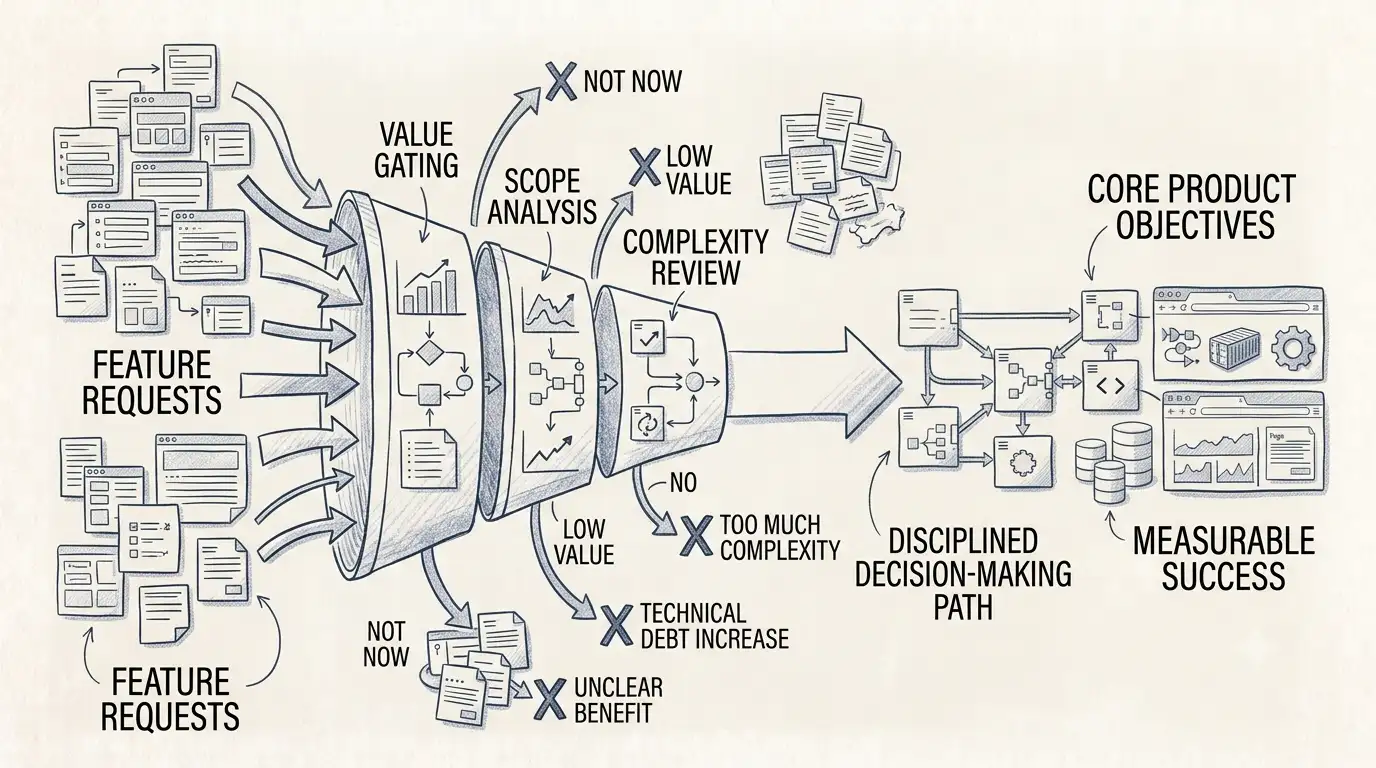

Software projects have a natural tendency to grow.
A feature is requested.
Then another.
Then an integration.
Then a report.
Then someone says:
“While we're doing that, can we also...?”
Each request sounds reasonable.
The problem is that nobody says no.
Saying yes has a cost
Every new requirement affects something.
It may add development time.
It may increase testing.
It may create another dependency.
It may make the interface harder to understand.
It may create maintenance work for years.
The cost isn't always obvious when the request is made.
That's why every project needs someone who can ask:
“Should we actually do this?”
Not just:
“Can we do this?”
“Can we?” and “Should we?” are different questions
Technically, many things are possible.
That doesn't mean they are worth building.
A customer may request a complicated dashboard.
A competitor may have a feature.
Someone may suggest adding an AI component.
The development team may be able to build all of them.
But the business still needs to decide whether they should exist.
Engineering isn't just about possibility.
It's about trade-offs.
Saying no protects the project
A good “no” should have a reason.
For example:
“This adds significant complexity but doesn't solve the main problem.”
Or:
“We can do this, but it will delay the workflow that matters more.”
Or:
“Let's test whether people actually need this before building it.”
That's very different from simply rejecting ideas.
You're protecting the project's purpose.
Scope isn't just a project-management concern
Scope is often treated as something project managers worry about.
It is also an engineering concern.
A project with too many requirements becomes harder to reason about.
Testing becomes larger.
Dependencies increase.
The original goal becomes less clear.
Eventually, the team is delivering more but achieving less.
Good teams make trade-offs visible
If a new requirement is important, include it.
But make the consequence clear.
For example:
“We can add this, but it means delaying X by two weeks.”
Now the decision belongs to the business.
That's healthy.
What isn't healthy is quietly adding work until the original project becomes something completely different.
Saying no doesn't mean being inflexible
There will be good reasons to change direction.
New information may appear.
A customer may change.
A regulatory requirement may emerge.
A serious problem may be discovered.
The answer isn't to reject every new request.
It's to make changes consciously.
The project should have a way to say:
Yes.
Not now.
Maybe later.
No, because it doesn't help us achieve the goal.
That discipline can save more time and money than another productivity tool ever will.